Checking Your Pulse
What does my heart do?

image courtesy of TheClipArtKid.com
Your heart is a pump and is central to your body’s engine. It pumps blood through your lungs to get rid of used carbon dioxide and swap it for oxygen out of the air you breath. Then it pumps that oxygen rich blood around the rest of your body so you can get active.
The pump works in spurts, as the muscle expands and contracts. It’s a pulsing action; and one you can feel if you know how. That’s your pulse.
Why is it important?
Your heart rate (or pulse) is the single most important indicator of your body’s ability to cope with exercise and exertion at any particular moment. You will benefit from keeping track of it when you are out on the hills.
Caution: Hillwalking is a strenuous activity. Consider if there are any reasons why you might need to consult a doctor before engaging in the sport.; whether you need to tell them what you plan on doing and to get their professional response.
What should my pulse rate be?..
Sharing is brilliant. It rewards me for my effort and encourages me to do more. Please share...

Mourne Country: More than just a skyline…
The intriguing and engaging skyline of the Mountains of Mourne is frequently visible from the coast of Red Island in The Skerries….

The broken skyline….
Transfixed by the vision of a broken skyline
Transfixed by the vision of a broken skyline, rising like some giant stegosaurus from the evening mist that glazed the Irish Sea; a man lingered on Red Island. Standing, roughly where the Percy French bench now stands, he turned to me and spoke. In an accent that marked him as a visitor, a traveller perhaps, he queried: What hills are those?… Mountains! I replied. They’re mountains! Never let it be said that the lack of altitude of our finest peaks makes them anything less than mountains. And from left to right I carefully and deliberately named them: Slieve Gullion; Claremont Cairn and Slieve Foy, land of the famed cattle raid of Cooley. And then one by one, the names of the Mountains of Mourne, lingering at the peak of Slieve Donard, the highest mountain in the North, made even more imposing by its majestic sweep into the sea. And finally pointing toward the cow and the calf (Rockabill) and explaining that it was from Mourne that the two of them had made their fateful journey. Leaving him, I thought, with the everlasting impression that those mountains were all of; magical, mysterious and inaccessible. But wholly undaunted he turned once more to me and asked: How do I get there, what else can I see, what is there to do?… Read more…
Sharing is brilliant. It rewards me for my effort and encourages me to do more. Please share...

Glendalough & Glenealo : An Easy Amble
Less than 50kms from the centre of Dublin, this valley with it’s enigmatic cultural landscape and sentinel village of Laragh, are worlds away from the prickly complexity of the city. Once it cradled those seeking a simpler life, nursing and dispersing the accumulated knowledge of European civilisation. Today if offers a unique glimpse into our heritage and a gateway to the Wicklow Mountains National Park.
This location provides easy and enjoyable walking for everyone, including families; and this blog entry provides you (below) with simple route instructions to navigate yourselves and companions safely around the valley on easy terrain…. but stout footwear recommended.
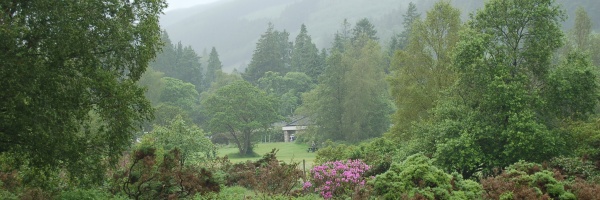
Your view across the valley toward the Wicklow Mountains National Park Visitor Centre
And if you are new to mountain walking, this little janunt gives you the opportunity to put yourself safely at the heart of the park, to go to the National Park Visitor Centre, and begin to familiarise yourself with the landscape, the flora and fauna that you will find on your way to the tops.
If you have access to a copy, then Walk 20, (Ancient Knowledge and Secret Places) of Best Walks in Ireland, will guide you along the Miners’s Road, past the old lead workings, to the source of the Glenealo River. Then, perhaps glimpsing heards of red-like deer, past pools in the bog, the man made Turlogh Reservoir (a kind of ESB natural battery) over the summit of Camaderry, and after a somewhat steep descent, back to your staring point. 11 miles and a strenuous day walk. Or if your facy takes, you can follow the route of the entire Glenealo watershed (Walk 20a). A bog trotters treat, 13 miles, 8 hours and difficult. But the book also contains around four other alternative suggestions for easier walks or where to find information on such.
Getting there ….
Go to the village of Laragh in Co. Wicklow and park your car in one of the small number of public car-parking spaces at the heart of the village there.
You can click on the Directions link on the Google map on the right to get route instructions from your location.
.
The Route …
This first part is on the road, so a little caution is required. But generally it isn’t busy, and since it forms part of the Wicklow Way, locals, at least, are aware they will encounter ramblers along the hedges.
- Leave your car and head South on the R755 towards Rathdrum for about 750m metres. Pass various modern B&Bs and other bungalows on your left to reach a bohereen running off to the right.
- Take the bohereen signposted to The Woollen Mills, toward the gates of Derrybawn House and follow it across the Glendasan River, rushing to join the Avonmore, just a few hundred metres south. (If the river isn’t rushing, it’s because we’ve had a dry-spell, which seems highly unlikely.)
- Stay right with the tarmac route as it turns into the yard for the Woollen Mills, and keep the Mills buildings on your right as you pass through a gateway and onto the sometimes metalled trackway that runs parallel to the right (true) bank of the Glendasan River you’ve just crossed; until you reach the boundary of the Wicklow Mountains National Park and the nature reserve; where a plaque explains the process of re-affirmation of the local forestry.
The prominent ruins down toward the river on your right are those of St Saviour’s, a twelfth century priory. Whilst considerably later than the monastic ruins associated with St Kevin, and surrounding the round tower that you will encounter later in your walk, this early example of Romanesque architecture with rounded arches, though concurrent with the early Norman occupation of Leinster, exhibits some interesting detail in its stone carving; and is worth the detour. Perhaps you could ponder on the circumstances that more than 800 years ago, gave rise to the building of a priory here. To get there, turn right off the track, through an obvious gate, down along the narrow earthen tread through this recently planted “pioneer” woodland with its birch, beech and sessile oak, sheltering sheep fescue, willow herb and speedwell; to a second gate which opens into an enclosure.
- Keep right at a fork and pass beyond a steel park barrier, until the trackway becomes a broad tarmac footpath.
- After roughly 1.5 kms from the Mills, arrive at the right turn junction for access to the Lower Lough car-park and Wicklow Mountains National Park, Visitor Centre. By all means divert here and explore the centre, or the monastic city or both; then return back to this junction; or to this track, by passing through the buildings and grounds of the monastic city to return to this track. Once back at this track turn right to continue following it up the gleann.
- Continue straight ahead, and quickly arrive at a fork in the pathway, by a spring splurge of herb robert.
- Take the right fork to follow the boardwalk, that will navigate you safely and with dry feet, across the valley floor and the Glendasan River
The eventual emergence of purple moor grass and blankets of bog cotton tell you that the valley floor is getting wetter as you pass. While the elder trees in the distance tell you that there are drier slopes on the far side. I would expect to see dragon flies, demoiselles and many other interesting insects here, in the right conditions and at the right time of year. As I pass they seem to be pressed low above the vegetation, where the hirondelle, (house martin, sand martin and swallows) are wheeling and carting in throng to feed up on them. And a couple of heron are secreted amid the reeds, preening and feeding.
- The boardwalk eventually reaches the far side of the gleann, by some large granite eratics (stones brought here by the actions of glacial ice, 10,000 and more years ago), and seeks to nestle beneath the R757 running (out of view) toward the car-park at the Upper Lough.
There’s plenty to see as you amble along; a stone cross; less common breeds of sheep; devils bit scabeous grasping a tenuous existence in the stone wall on your right. Perhaps you will notice how differently the birch trees and the willow at the water’s edge behave in the breeze. The leaves and branches of the birch fluttering in some organised chaos, whilst the willow sways and eases its way through the oncoming wind.
- Stay with the boardwalk as it eventually resolves to a tarmac path and at the next obvious junction, fork left, to immediately cross over the Glendasan River and instantly reach a second fork: The way directly ahead (left fork) takes you straight ahead back across the gleann to turn left at the next junction with the green lane (tarmac) and so steer you back toward the monastic city…..
But unless you are in some kind of hurry, turn right, enjoy the delights of the location. There are various “visitor facilities”. Cafe, toilets, picnic tables, open spaces, the shores of the Upper Lough and the Visitor Information Centre. Plenty of flora and fauna, spaces to amble and vistas of the cultural landscape.
- When you are ready to return, follow the signs to the Information Centre, resembling a small house. Tarry a while longer here. There is plenty to see and the wardens are always full of interesting and useful information.
- To continue your route: Face the front door of the centre and look right. That’s the direction back along the gleann. Follow the tarmac path (green road) and the signs taking you back toward the monastic city; as you walk, the car-park will be on your left, and the shores of the upper lough, behind you.
- Keep endway along the path, passing a delightful waterfall on your right and the Glendalough and Laragh Anglers memorial stone on your left, eventually to arrive back at the monastic city, the two path junctions from earlier in your walk, and to recover the track back toward the woollen mills.
- Finally, retrace your steps from the mills to return along the A755 into Laragh to summer evening scents of honeysuckle and to the safe harbour of the village heart, and your parked car.
That’s it. Of course there is so much more to the natural and cultural landscape of this valley, than this meagre commentary, still I hope you enjoyed the walk, and that your interested has “piqued” enough for you to want to explore further.
Sharing is brilliant. It rewards me for my effort and encourages me to do more. Please share...

Spinkwee : Around the yellow crag…
Spinkwee Watershed
The Mountains of Mourne
6-8 hours with breaks
Challenging/Strenuous
Navigation skills essential
Mountain walking experience advised
A truly comprehensive and inspiring ramble
Sometimes I like to cover distance…
…and enjoy the change of mountain scenery as I make like some express train over a beaten tread; it’s the “rhythm of the walk” I’m enjoying. But at other times I love nothing more than to amble and explore, preferably in the best of near-wilderness I can find; then it’s “being in the place” that I find so fulfilling.
One favourite such haunt of the past is that area of the Mourne Mountains not much frequented by the path-bound rambler. Framed by the Trassey Track, to the east, the Glen River to the west, Mourne Wall to the south and with pedestrian access well filtered through the Tollymore Forest Park to the north. You can meander and mosey, saunter and stroll without ever seeing a soul except perhaps a shepherd and dog working a flock, or the more adventurous urban walker strolling through the fringes of the Forest Park. And in particular I have one favourite route I’ve always called the Spinkwee Watershed. So I set-off with Shash this Sunday morning with the intention of reviving a few old memories and exploring these much neglected slopes once again. (Spinkwee: Spinc Bhui – Yellow Crag). A distinctive and prominent crag that can be seen on the slopes of The Corragh above the source, and from which the river seems to have acquired its name).

The view SSW from the summit cairn across the Commedagh boola toward The Mourne Wall tower (left). In the centre, Slieve Binnian shows in the distance.
Quality & Character
I love this route. It’s awesome in so many ways, yet so simple, so available. There’s a good mix of woodland and open mountain; distant vistas, intimate nooks & crannies, flora and fauna. Plenty to pique your interest or cause you to ponder. On this trip only our views to the west were un-hindered by cloud and we easily spotted every notable feature in the distant landscapes from Belfast and Strangford Loughs to the Isle of Man, Carlingford Lough, Clougher Head and the Cooley Mountains. A large vixen trotted freely back and forth across the open mountain named after her kind (Slievenamaddy) as if to parade her right to be there. And though we didn’t spot any badgers, (Slievenabrock), there were plenty of pipits, wheatears, and larks; and separately a couple of buzzards made a brief soaring appearance. Late spring flowers were in abundance and included: Milkwort and Tormentil, as well as the usual bilberry, bog cotton and bell heather. And we easily found lots of great places to lay back and relax.
But, the real surprise is that this route conceals the finest “vista discovery” of any walk in the Mourne. I know that in recent years, evidenced by the ever-eroding thread that winds its way from Commedagh and over Tullybrannigan (Tulaigh Uí Bhranagáin/Brannigan’s Hill?, labelled rather vaguely on the map) that the practice is to descend from the tops by this way, but the gift of the ascent by this route is truly unparalleled anywhere in these hills, perhaps anywhere in Ireland. Not only are you both taunted and entertained as you ascend; views into Newcastle, Murlough and the coast; back toward Belfast or Strangford; maybe into the Glen River or the Pot of Legawherry, perhaps over Luke’s Mountain and Slievenaglough; but the vista that opens before you, and around you, as you progress the last few metres to the summit cairn of Commedagh is truly an inspiring experience. And if the ascent has already taken your breath away, I promise you this outstanding reward. So when you get there, just slump down by the cairn, rest yourself a while, and drink in the beauty that surrounds you; the physically hardest part of the day is over.
Grade : Challenging/Strenuous
I’ve graded this route as challenging/strenuous for three reasons:
- You need to be reasonably fit, because of the terrain and the distance; and if you choose not to take the tourist route (ie zigzag) up the various slopes, but aim directly for the summits, you will exercise your thigh and calf muscles. If you zigzag you’ll be working your ankles quite hard. In any event, a good stretching routine, before, after, and the day after will serve you well.
- You need to have some hill walking experience. There are some challenges underfoot, both on the beaten treads along the Mourne Wall, and ascending and descending open mountain. Knowing where to place your feet on the terrain ahead of you will make life much easier.
- You need to be confident navigating with map and compass. Whilst this is an easy route for topographical navigation, if the rain and cloud descend (which can happen in about 10 minutes in the Mourne) you’ll need to be able to work your way around. Even in fog, don’t use a GPS other than to confirm your location and perhaps suggest the broadest bearing. Safe navigation on this route requires some meandering even on the tops; thumbing your way along the map should be a habit.
Time
If you don’t give this route 6 hours, you’re rushing and not doing is justice. You could easily take 8 hours if you have any kind of curiosity.
Map
OSNI Mourne Country Outdoor Pursuits Map. Scale: 1:25000
OSNI Mournes Activity Map. Scale: 1:25000
OSNI Discovery Series Map. Scale: 1:50,000 Use in addition to the 1:25,000
The Route
Thumb this on the Mourne Country 1:25000 map before setting off for the walk and make sure you are clear about the route and alternative options for the descent or escape. By all means make yourself a route card, mark up your map and advise others on where you are going.

Looking back toward the Tullybrannigan gate
Pegging through Tollymore Forest Park: You’ll need a lift, or a car. Start from the neat car-park at the North end of the Trassey Track and the foot of Clonachullion Hill. (MR J 311 314) ). Set off Eastwards along the route of the Ulster Way and into Tollymore Forest Park. Follow any route that suits you to find your way to The White Plains just SW of The Drinns at map ref: MR J 338 312. As you follow the forestry track uphill away from the river, look for the faded, red oxide painted, iron & steel gate in the wall on your right. Find the stone stile to the right of the gate and cross the wall.
.
Ascending Commedagh: Aim for the summit of Slieve Commedagh by heading roughly SW from the wall, passing over the summits of Tullybrannigan, Slievenabrock, Shan Slieve and Commedagh to reach the Commedagh tower of The Mourne Wall. (In all, the most strenuous part of the walk).
Alternatively choose your own route to the summit, there are plenty of options, for example:
- You could work your way South along the right bank (true) of the Spinkwee heading toward the Tullybrannigan boundary wall and then following the tributary or the boundary wall SE into the saddle between Slievenabrock and Shanslieve;
- Or for the more experienced seeking a stiffer route, cross the tributary and the boundary wall and head deeper into the corrie, past the obvious escarpment until you find a satisfactory route SE to make a steady but demanding ascent into the saddle below Commedagh.
- And for a more progressive gentle ascent, though a bit hard on the ankles, you can contour SEwards and upwards around Slievenabrock on to a NE running spur called Slievenamaddy at approximately MR J 354 297 and make your final attack on the summit of Commedagh from there.

The profile of your ascent from Tullybrannigan to Commedagh. And The Mourne Wall running over The Corragh
Following The Wall: Cross The Mourne Wall by the wooden stile (MR J 344 285) and turn WNW undulating your way amid rocks and ponds and isolated hags, across The Corragh (An Corrach) to the westerly second peak of Slievenaglogh. Don’t be afraid to foresake The Wall and the shredded ribbon path that seems to worship it’s proximity, to drop off the ridge and meander along the slopes above the Brandy Pad and amid the turf-scoured landscape that is the source of the Kilkeel River. And once the summit cairn of Slievenaglogh is made you have a great choice of routes back to the start; though your final choice may be influenced by the amount of daylight left, the weather, and any tiredness experienced by you or your party.
From Slievenaglogh: On this occasion it was fast approaching 7pm when we arrived at the Slievenaglogh cairn; and during the earlier 30 minutes, the cloud base had dropped hiding most of the summits; and upon reaching the cairn the rain became torrential and visibility dropped to perhaps 20 metres. And so after exploring a little of the steepening north-western slopes of Slievenaglogh we chose to re-cross The Wall just above the Slievenaglogh Slabs (above the upper reaches of the Trassey River) and take the safest (Descent 1) of the three options below.
- Descent 1: Trassey Track : Continue along the south side of The Wall into Hare’s Gap (MR J 323 286). Slip through the gate in The Wall and boulder hop your way down the Trassey River to follow the Trassey Track (and its variants offering a softer tread) back to the start. And while this route increases the variety of terrain found in this walk, there are many who find parts of the Trassey Track uncomfortable underfoot after a long day of rambling over open mountain. Be prepared to take your time.
- Descent 2: The Spur of Slievenaglogh: Requires caution. Cross to the North side of The Wall and descend NW along the spur of Slievenaglogh to meet the Trassey Track around its junction with the Clonachullion plantation; and so back to the start. WARNING. The warning is in the name: A mountain of stones or rocks, ready to deceive the unwary. Descending Slievenaglough is not difficult. But there are the Slievenaglogh Slabs and other granite buttresses over which, from which, you may fall; and until you are familiar with the mountain it is safer to veer to the right and not be tempted down the western slopes of the spur of the mountain… You can do this by following a bearing to the summit of Chlonachullion Hill; about 330º True. This will track you a little to the right of the crest of the north-west running spur.
- Descent 3: Luke’s Mountain: A favourite of mine, but one I’ve not done for a while, so explore with care. Once over The Wall, head directly North for the summit of Luke’s Mountain (MR J 328 304)… generally you’ll see the ponds ahead of you. 3.1: From there drop down NW toward a farm road running around the NE and N of Chlonachullion Hill that will take you back to the start. 3.2 Or drop down N then NE toward and obvious wall and track which you can follow back into Tollymore Forest Park for a chance to stretch out your legs and get an easy rhythm on you way back to the start. 3.3: Or choose your own route. Again there are lots of options, with open mountain, tracks, sheep treads and streams.
That’s it. Set out early, take plenty to eat and drink, watch where you step, amble and enjoy.
Other Routes:
Whilst crossing The Wall by the tower on Commedagh, you may peer generally toward the hills immediately to the south. And gaze with some curiosity at the ribbon of peaks that form the Annalong Horseshoe. Having written about that several times before I do have a draft ready to test and publish here perhaps before the summer of 2017.
Caution
The Mourne Mountains are steep. The backs of corries such as the Pot of Legawherry or the Pot of Pulgarve are especially steep. Additionally the terrain is littered with buttresses, boulders, tors, towers, holes, crumbling hags, hidden ponds and small cliffs. It’s very easy for the unwary to tumble, and for that tumble to turn into a fall. I know, over the years I’ve had my share.
Drop me a line or offer a comment, if you know these routes, if this entry inspired you to go exploring there, or if you just have something to ask, or something you want to say…
Updated: 07 September 2016

Commedagh, Newcastle Bay & Donard
Sharing is brilliant. It rewards me for my effort and encourages me to do more. Please share...

Wood for the living, stone for the dead
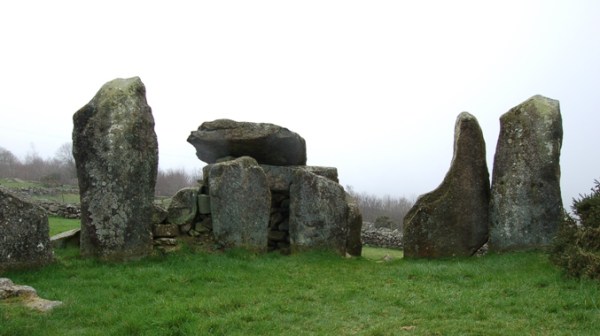
Stones for the dead : The Clontygora Court Tomb, Cooley Peninsula, Co. Armagh
Wood for the living, stone for the dead, goes the thinking. That’s how today’s archaeologists think our ancestors, the ones that lived before the ages of copper, bronze and iron, would have seen the world. It’s why we find post-holes with pottery and human remains in stone chambers; in sites created more than 5000 years ago. We call it the “stone age”… the age before metals; and know it most readily from the lasting legacy implanted in our landscape “megaliths”…or big stones.
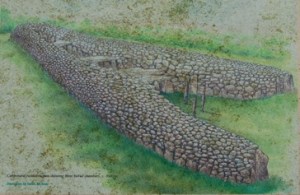
An artists impression of the complete tomb.
Featuring mainly in parts of the West, but especially the North of Ireland, The Ulster Journal of Archeology speculates that the technique, and presumably, therefore, the culture, for building these tombs, came across the narrow North Channel from south-west Scotland, where similar examples are cast within the landscape.
Of course it could be the reverse, (as is often suggested with the Kingdom of Dál Riata further North), which ever direction it does place this site at an important stone age crossroad.


 Best Walks