Opinel pocket knife : Quick Review
Trekking deep into a volcanic cirque on an island in the Indian Ocean was inspiring. But as we progressed into the evening, the vegetation became more dense. And soon there wasn’t even enough space for us to put down our mats and sleep. Not expecting this we had no machete of the kind you see in Hollywood movies, nor a Bowie knife nor any kind of hunting knife, to help us clear a patch of undergrowth and make a place to sleep…

Cirque de Mafate, Reunion Island, Indian Ocean
Sharing is brilliant. It rewards me for my effort and encourages me to do more. Please share...

Discovering the Boyne : Green Way
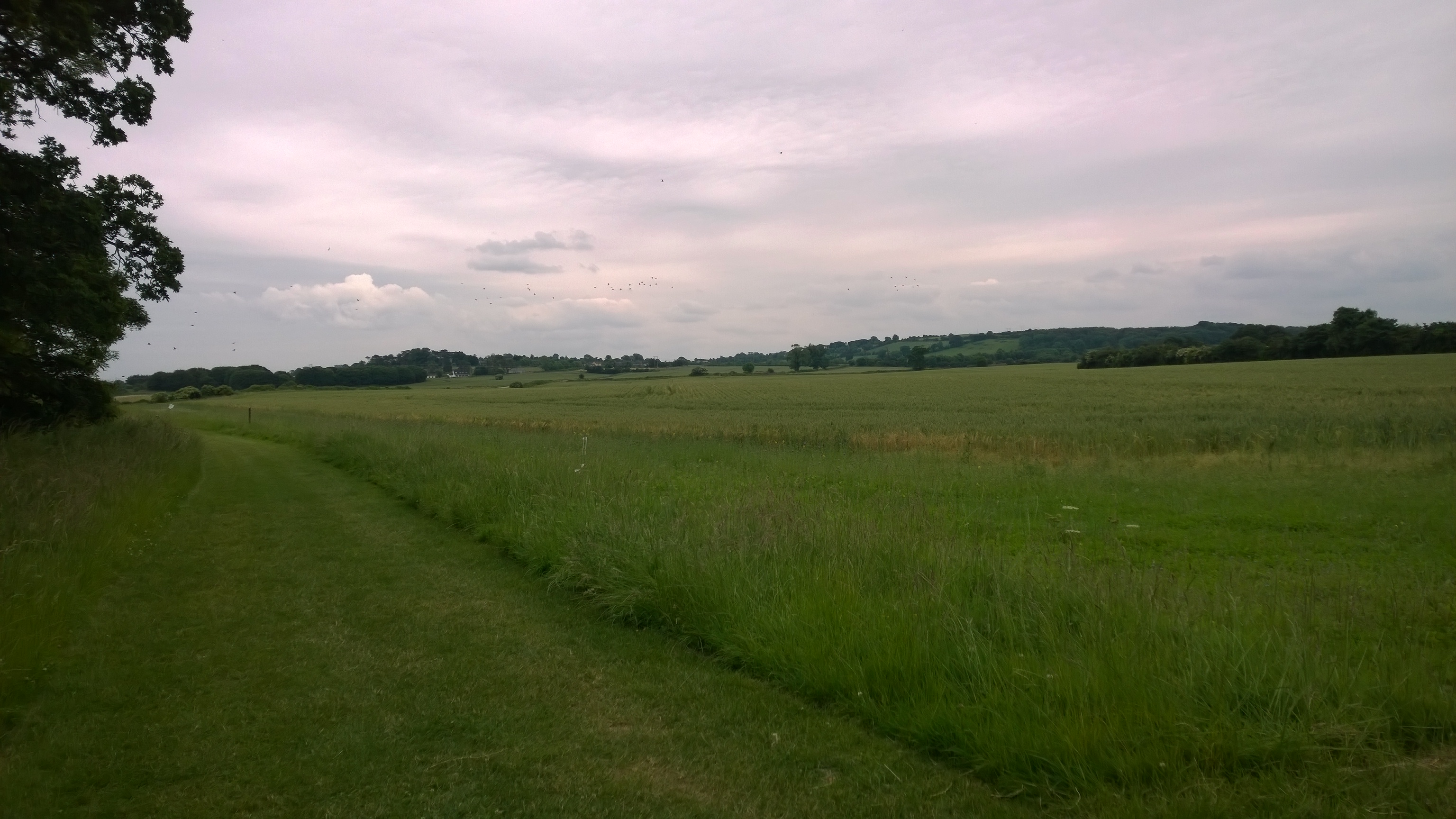
Perhaps, because it is the home of so much history and heritage we can sometimes forget that the valley of the River Boyne is an astonishingly beautiful garden landscape and truly a land not just of a thousand welcomes, but most definitely, of a thousand greens. The walks and walkways outlined here give you and your family a chance to discover this enchanting and endearing countryside; and maybe to come to understand a little of our past, in a safe secure adventure.
The GreenWay…
Sharing is brilliant. It rewards me for my effort and encourages me to do more. Please share...

Finally…
 Finally, with great kit in my sac, the right gear on my back, and myself now in Ireland, I’m out here walking and talking. Chatting to people about places and past; dreams and more dreams; and opinionating liberally on the way.
Only a couple of years later than planned. But isn’t that always the way of it. Beidh sé go deas bualadh leat aris…
I’ll be back soon now…
Update August 2014: Sadly the publisher informs me that they will no longer be publishing titles in the Best Walks series. There will be no printed update to Best Walks in Ireland.
Sharing is brilliant. It rewards me for my effort and encourages me to do more. Please share...

Light My Fire : Spork Original & Extreme
Light My Fire Spork Original
throws a leftie, gets small, goes large & boasts EXTREME.

As we reach cruising altitude the seatbelt lights go out, the pilot’s voice crackles its way out of the overhead speakers and the serving trollies start rumbling past our seats. Berni roots around in a bag and hands me a recyclable plastic tub, with vague exotic scents hinting at the pre-cooked Moroccan couscous crammed inside. It’s a habit we have now, and I’m already prepared having slipped my fork out of a small polythene freezer bag ready to plunge it into the cracked bulgur, durum wheat and roasted vegetables mix. There’s nothing like home-cooked food when you’re long on the travelling.
Except it’s not a fork that I’m holding, it’s a well made, food grade, plastic eating utensil, one of several I’ve been carrying since sometime after the 9/11 security measures forced me to leave my MSR titanium knife and fork at home. This one passes security with ease, and is strong and robust enough for most situations when I’m eating on the go; be it a plane, bus or train; camping, trekking, walking, mountaineering, bird-watch snacking, out on the boat, kayaking to the local islands, or just out, away from the crowds, for a simple pic-nic.

An Sporc ?
Well it might have been called that if it were Irish. But it’s actually made by Light-My-Fire a home grown Swedish company, succeeding at adding value to a limited source of raw material. Something small businesses are aiming to do here in Ireland. Now they call this tool a SPORK. And it’s a great example of the products conjured-up by their unique business mission; for Light-My-Fire specialize in outdoor accessories designed, they say, to be as practical in the city as they are in the wild; and to be of use to everyone from the backyard adventurer to the backwoods survivalist.
The plastic Spork certainly lives up to that objective; which is probably why by 15th of January 2014 they’d sold a whopping:
20,985,148 Sporks
into 52 countries, and all made in their one factory (as are most of their products) in Västervik in Sweden.

What if ?
But even this versatile little eating tool has it’s limits. Whilst I’ve never tried to use one to remove a thorn from an elephants foot, I can’t imagine it would be strong enough; neither do I imagine it would prove very useful for roughening the leather on your boots ready for a field repair, or canvas tent fabric before gluing… Neither can you use it in or close to a flame, say as a frying pan slice, or a solid fuel fire poker… it would just melt. Now if it were made from Titanium…

Titanium material means it is:
lightweight
strong
sufficiently rigid
17 cms long means
comfortable to use
easy to stow
Soup spoon measuring bowl
10ml, or
2 teaspoons
Practical fork profile suitable for
stabbing food
scooping food
Serrated cutting edge
safe design,
cutting/chopping some foods
useful for gutting/abrading/scraping
Sharper edge?
As a regular user of the plastic Spork I’ve found the serrated “blade” running alongside the one side of the fork to be a surprisingly useful feature, well able to allow a cut/chop motion for dividing up piece of food as I’m eating. So I was a little disappointed when I encountered the same feature on the titanium version. I felt it could have been a little more “aggressive” in the way it was implemented. So I spoke to Light-My-Fire who were good enough to send me a new titanium sample that represented a well finished Spork. It was pretty much identical to those I already owned, so I asked them about this “blade”. When they explained their main concern, it made sense.
A serrated edge in the titanium Spork, with the same profile as the plastic edition, is going to deliver a far more serious tearing effect; and given that the fork end is designed for people to put in their mouth, and might end up in the hands of children, Light-My-Fire say they have taken pains to ensure that the titanium Spork is safe for the vast majority of users. Here’s the detail:


On the plane…
Regular flyers will be well aware of the vaugaries and inconsistencies of airport security. I’ve never had a problem carrying on a plastic Spork. And last year I travelled several times with my titanium spork stowed inside the chimney of my Kelly Kettle. I removed the kettle from my rucksack and placed it on the airport security conveyor belt to openly offer it for separate inspection. On the last occasions, as an example, airport staff handled the stove, removed it from its bag, dismantled the assembled parts, checked that there was no fuel in the stove, asked me various questions, but made no comment about the Spork. However, I can’t guarantee you’ll have the same experience.
Price ?
So how much for this paragon of adventuresome cullinary functionality? Some retailers seem to be asking around €5 or €6 each, but you can find it for €3. Here are a couple of examples from Alpine Sports and The Irish Scout Shop.
The titanium version seems to be available for as much as €24, but if you scout around (forgive the pun, ) you can find it for as little as €15 and at that price, and anything up to €18, it represents great value for the active outdoor enthusiast. I wouldn’t be without mine. Here’s one from 53 Degrees North for €17.10
The Links…
- Light-My-Fire’s web site
- Light-My-Fire’s SPORK page
- Light-My-Fire’s Adventure Blog
- Light-My-Fire’s page on: Facebook
- Light-My-Fire’s SPORK on Youtube
History, origins and early designs…
What the Wikipedia has to say about : The history and origins
More about differing designs and their uses : sprork.org
Meafeic (Summary)
A simple but well designed, and well crafted single eating utensil. Originally manufactured and widely available in high grade food plastic, now also available in more durable titanium. Suitable for everything from a back garden pic-nic through to snacking on the side of a mountain; and as a cooking utensil when made in titanium. Really can’t imaging why everyone wouldn’t have one; which probably explains why 21 million have been sold to date.
Share ?
Like the product? Enjoyed the review? Then please share it with your circle…


Sharing is brilliant. It rewards me for my effort and encourages me to do more. Please share...

“Buen Camino”
Book review : Buen Camino : A Father-Daughter Journey, from Croagh Patrick to Santiago de Compostela. Written by Natasha and Peter Murtagh and Published by Gill & Macmillan on 25 March 2011 for €16.99/£14.99.
To begin : A recollection from my own Camino …
The village, hamlet really, has lodged itself at the end of the ridge Shash and I are walking. Late July, gone midday and with the temperature in the thirties, we find a welcome stone table and benches in the square. As our sacks slip to the ground, we take a moment to recover and let the landscape absorb us.
We are following the Camino on our way to St Jean Pied de Port. Lunchtime in rural south-west France is always respected; machines are turned off, tractors are parked, artisans put down their tools. Even the dogs stop barking. And so, conscious even of the noise we make rummaging around our sacks, we pull out a baguette and a chunk of mature brebis (ewe’s cheese) and begin to prepare to eat.
Moments pass and the window of a low single story building is flung open. Except we see later that it’s a large house, snuggled into the side of the mountain, so that only the top floor shows toward the square. And from the shade of the overhanging terracotta tiles comes a shout: De l’eau fraiche? A call so full of mountain honey that it just melts away without seeming to disturb the silence. And with that, the window closes again.
A gate squeaks. It is wrought in iron and swings gaily on its hinges. I’m guessing wood doesn’t last long here; and it’s job is to keep out the sheep and the cattle from the potager (vegetable garden) as they pass from field to field through this small but functional square.
In his working clothes, waistcoat and beret, (he’s Béarnais) he canters across the short space, arms in full embrace of precious contents. He puts down two litre bottles of chilled water, du frigo, from the fridge, but not too cold; a couple of leaves of lettuce and three very large tomatoes, that he pulled from the vine and washed for his own lunch. He’s the village caretaker and after a little chat about us and our journey, him and life in the village, he leaves us to enjoy our meal while he attends to his own.
Sometime later he re-appears jangling a set of keys, he wants to show us La Salle, the function room, that all the villagers have been busy restoring. It’s for weddings and feasts he says. It’s clearly a long time since he spoke English, but the smile that comes with it says everything. La Salle is superb, and full of character and what we smug dwellers of the industrial era like to call “old world charm”…
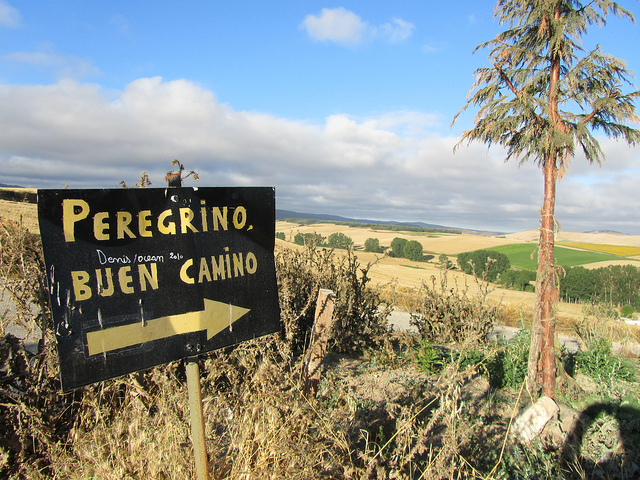
“Buen Camino peregrino…”


 Best Walks